We offer a new customer discount for first-time buyers.
We offer not only the current bestsellers on the market, but can also customize a tent just for you.
When Lab Specs Meet Real-World Conditions
A picture is worth a thousand words.
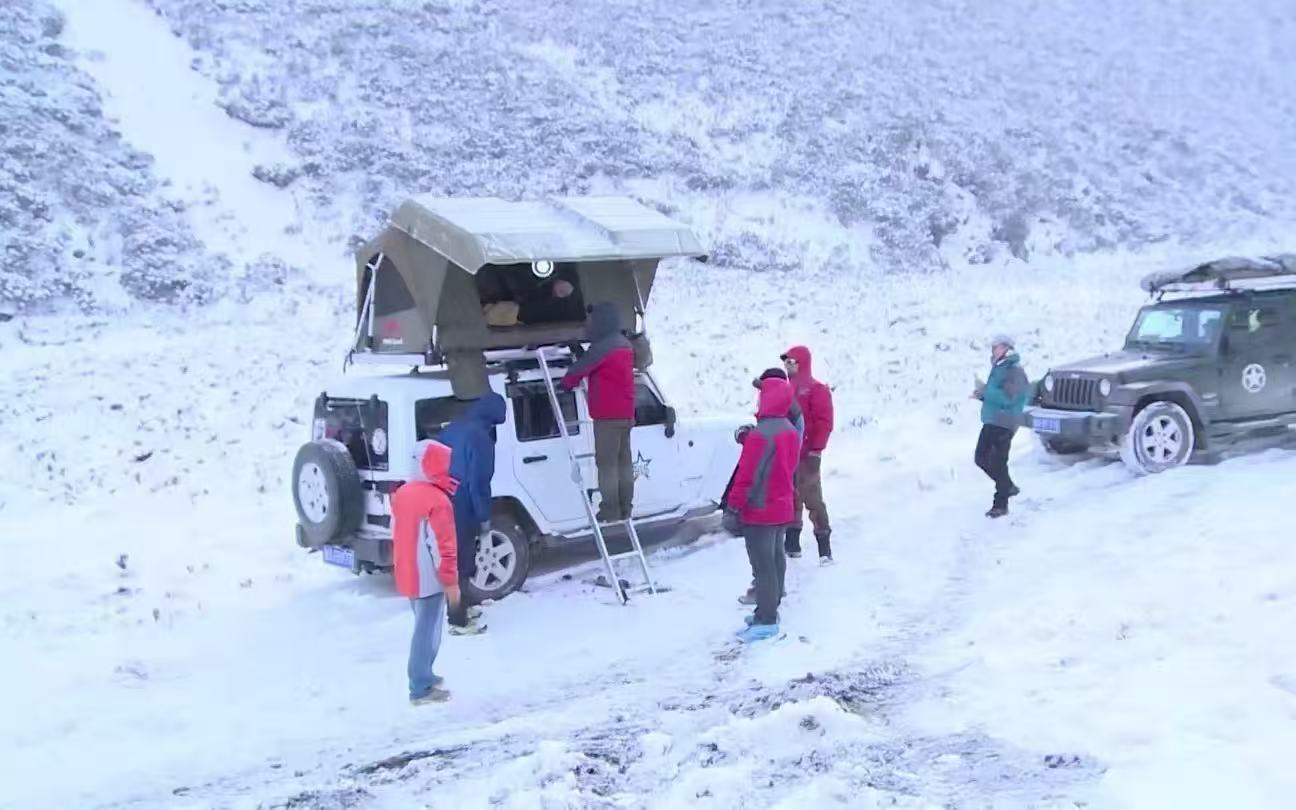
In the frame, a white off-road vehicle sits on a snow-covered mountainside. The AlpinePeak rooftop tent is fully deployed overhead. Test crew members in heavy cold-weather gear are gathered around — one climbing the ladder to inspect the tent’s interior. Behind them, a snow-dusted Jeep Wrangler waits in the distance. This isn’t a studio setup. This is AlpinePeak’s real-world extreme cold performance test at high altitude.
Most rooftop tents claim an operating temperature range of -10°C to +40°C. But serious overlanders know that camping rarely happens inside the “comfort zone.”
Western Sichuan, Northern Tibet, the Altay Mountains, the Greater Khingan Range — China’s most popular self-drive camping destinations regularly see nighttime temperatures plunge below -20°C in winter. Factor in the altitude temperature drop of roughly 6°C per 1,000 meters of elevation gain, and a rooftop tent deployed above 4,000 meters faces conditions that push far beyond what most spec sheets consider “safe.”
If a tent’s fabric becomes brittle, zippers freeze shut, frame warps, or seals fail under these conditions, the consequence isn’t just a bad night’s sleep — it’s a safety issue.
The test was conducted at approximately 4,200 meters elevation in a high-altitude snow environment. Ambient temperature ranged from -18°C to -22°C, with gusts reaching 45 km/h. The test team monitored key performance metrics continuously over 48 hours:
① Low-Temperature Fabric Resilience
AlpinePeak’s 600D polyester Oxford fabric undergoes specialized low-temperature plasticizer treatment. After 50+ repeated open-close cycles at -20°C, no visible cracking or coating delamination was observed. Critical seams use a dual-process system (high-frequency heat-welded + stitched), effectively eliminating the common failure mode of adhesive strip hardening and detachment in freezing conditions.
② Frame System Structural Integrity
The aluminum alloy / composite hardshell lift-frame mechanism operated smoothly after thermal contraction in extreme cold — no binding, no abnormal noise. The ladder-to-deck connection remained stable under a 150 kg static load (simulating two adult males), with no measurable deformation.
③ Sealing & Thermal Performance
The upgraded insulated inner liner, combined with the double-layer shell construction, maintained an interior temperature 12–15°C warmer than ambient at -20°C external temperature — relying solely on body heat, with no supplemental heating. Door and window zippers feature anti-freeze design and continued to operate smoothly even when surface frost was present.
④ Wind Resistance
At peak gust speeds of 45 km/h, the complete tent structure held firm. The anchoring system (tension straps + ground stakes) showed no loosening or failure. The hardshell roof’s aerodynamic profile effectively reduced both drag and wind-induced vibration.
At AlpinePeak, we don’t believe in “good enough.” In outdoor equipment, “good enough” is another way of saying “not good enough.”
Every data point from every extreme test feeds directly into our next product generation. From fabric formulation to hinge design, from zipper selection to sealing technique — each improvement traces back to real-world validation like this one.
Because the customers who truly trust your gear don’t only head out on sunny days.