We offer a new customer discount for first-time buyers.
We offer not only the current bestsellers on the market, but can also customize a tent just for you.
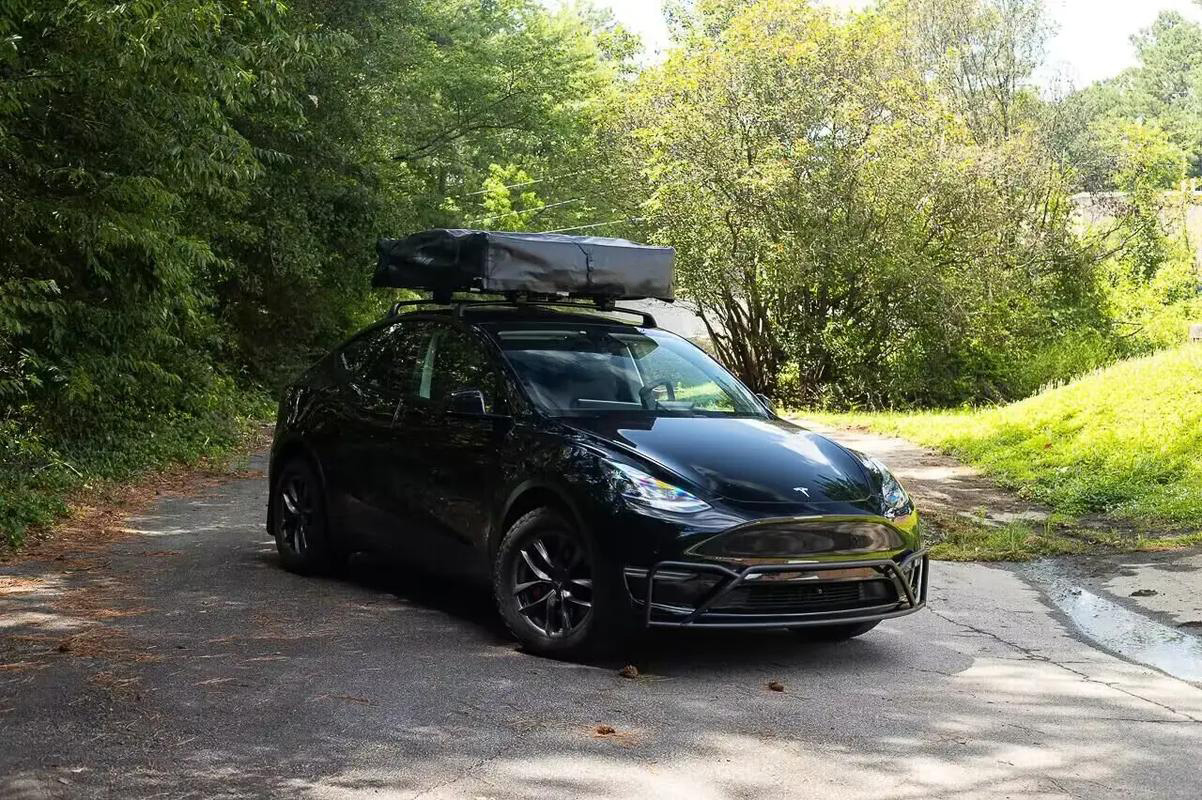
For over a decade, the rooftop tent was the domain of the diesel-powered Land Cruiser and the lifted Jeep Wrangler. Overlanders built their kits around internal combustion: roof racks, heavy-duty suspensions, jerry cans for extra fuel, and portable generators for camp power. The formula was proven — but it was also loud, dirty, and increasingly out of step with where the automotive world is heading.
That formula is now being rewritten from the ground up.
In 2026, electric vehicles are no longer a question mark for the overlanding community — they are an emerging platform. And the rooftop tent industry is scrambling to catch up.
The single biggest shift isn’t about range or charging speed. It’s about power delivery.
Most modern EVs — from the Ford F-150 Lightning to the Rivian R1T, from Chinese exports like the BYD Shark 6 to European offerings — now come with Vehicle-to-Load (V2L) capabilities, delivering 2.4 to 3.3 kW of onboard power. For rooftop tent campers, this changes everything: no more portable generators, no more propane stoves, no more dead phone batteries at dawn.
Think about what a single power outlet on your truck bed or cabin can do: run a portable fridge, charge drone batteries, power a camp light system, heat an electric blanket on a sub-zero night, even brew espresso. The EV doesn’t just get you to camp — it powers the entire camp.
In August 2025, Ford filed a patent with the USPTO for a roof-mounted shelter system designed specifically for pickup trucks. Unlike conventional rooftop tents that unfold laterally, Ford’s design extends longitudinally along the truck bed — from the roof to the tailgate — maintaining the vehicle’s full width profile. The collapsed form even resembles a streamlined tonneau cover, optimized for aerodynamics.
While Ford’s patent drawings don’t specify electric-only platforms, the design is strikingly compatible with the Lightning’s bed layout and power architecture. Whether Ford ever commercializes it or not, the signal is clear: OEMs are beginning to think of rooftop tents as part of the vehicle’s native capability set, not an aftermarket afterthought.
In September 2025, Shenzhen-based Huabao New Energy — parent company of the globally recognized Jackery portable power brand — secured a utility patent for a rooftop tent with integrated solar panels and a phase-change cooling system. The solar panels are mounted on the tent’s outer shell, while a thermal dissipation layer on the back side maintains optimal panel efficiency even under direct sun.
The implication is elegant: your tent captures solar energy during the day, feeds it into the vehicle’s battery or a portable power station, and at night the vehicle powers the tent’s lighting, heating, and device charging. A closed energy loop that turns your campsite into a self-sustaining micro-grid.
For off-grid overlanders who once budgeted kilowatt-hours as carefully as water, this is a paradigm shift.
Perhaps the most aggressive move comes from China, where vehicle manufacturers are already bundling rooftop tents into factory-built packages.
The Dongfeng Venucia VX6 “Rise Edition,” launched in early 2026, ships from the factory with an integrated rooftop tent system — 2.0m × 1.6m sleeping space, ABS hardshell, 600D Oxford fabric with an 8,000mm waterproof rating, and a rated load capacity of 350 kg. The vehicle’s seats fold flat to create a secondary sleeping platform, together accommodating up to five campers. Its 3.3 kW V2L system powers both the tent and a built-in tailgate kitchen module with an induction cooktop.
This isn’t a concept. It’s a production vehicle you can buy today.
Meanwhile, BYD’s Shark 6 plug-in hybrid pickup — now being rolled out across Latin America, the Middle East, and Southeast Asia — is being positioned as a work-and-play platform, with overlanding accessories as a core part of the marketing narrative. Chinese overlanders are already retrofitting BYD SUVs with hardshell rooftop tents, and social media interest is surging.
It’s not all smooth terrain.
Electric vehicles face a unique challenge that ICE overlanders never had to worry about: curb weight sensitivity. Adding a 60-75 kg hardshell rooftop tent to a vehicle already loaded with battery packs can measurably impact range — sometimes by 8-12% on highway driving due to increased aerodynamic drag and the added mass.
For brands like AlpinePeak, this presents both an engineering challenge and a competitive opportunity. The rooftop tent of the EV era needs to be lighter, more aerodynamic in its stowed form, and smarter about how it integrates with the vehicle’s power architecture — not just another box bolted to crossbars.
At AlpinePeak, we believe the next generation of rooftop tents shouldn’t be retrofitted for EVs — they should be designed from the ground up for them.
That means:
The overlanding world spent a decade perfecting tents for diesel trucks. Now the truck has changed — and the tent must evolve with it.
The mountain is still there. What’s different is how you power your way to the summit.